Steep Angle Belt Conveyor for Grain Handling | Kunwei Machine
Gentle Grain Handling Without Breakage or Dust Build-Up
Grain storage and agricultural processing facilities face a costly contradiction: moving large volumes efficiently often comes at the expense of grain integrity and site safety. Conventional conveyors and bucket elevators introduce repeated drops, sharp transfers, and high-impact loading points. The result is fragmented wheat and corn, excessive fines, and combustible dust accumulating where it shouldn’t. The DJ Series steep angle belt conveyor for grain handling was engineered specifically to break this trade-off. It transports grain at steep inclines while preserving kernel integrity and minimizing dust generation through a controlled, pocket-based conveying design.
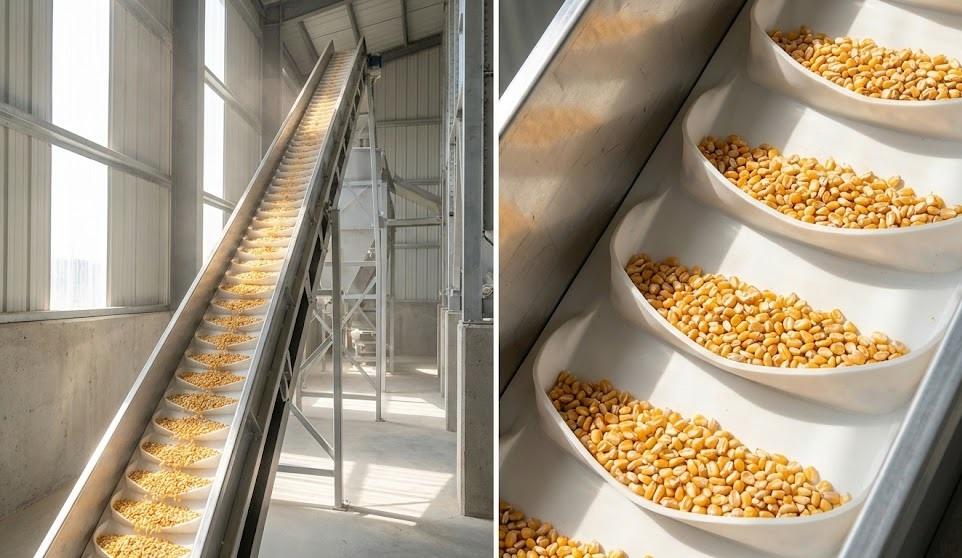
Steep Angle Belt Conveyor for Grain Handling
Where the DJ Series Is Used in Real Grain Operations
- Inbound receiving at grain elevators: Smooth pocket loading reduces initial impact when wheat or corn enters the system.
- Silo-to-silo transfer: Continuous belt movement eliminates repeated discharge points that typically cause breakage in bucket elevators.
- Port and terminal loading: Steep-angle capability allows compact layouts while maintaining controlled material flow.
Unlike traditional bucket elevators that rely on scooping and dumping, the DJ Series uses molded pockets formed by sidewalls and cleats. Grain remains supported throughout the lift, experiencing lower mechanical shear and far fewer collisions between kernels.
Technical Specifications for Grain Handling Applications
| Belt Width (mm) | Incline Angle | Typical Capacity (t/h) |
|---|---|---|
| 500 | 30–90° (Vertical) | 20–60 |
| 800 | 30–90° (Vertical) | 60–150 |
| 1200 | 30–90° (Vertical) | 150–350 |
| 1400 | 30–90° (Vertical) | 300–600 |
Throughput is not only a function of belt width but also belt speed. For grain, we intentionally optimize belt speed to balance capacity with kernel protection, avoiding excessive velocity that can increase impact energy and dust release.
Engineering Details That Protect Grain Quality
The DJ Series uses an open-type sidewall construction, allowing operators to visually inspect material flow and clean the belt easily between crop changes. This open design prevents grain from accumulating in hidden corners, reducing the risk of moisture retention, mold growth, and cross-contamination.
Cleat spacing is engineered based on the natural angle of repose of wheat and corn. By matching pocket geometry to the grain’s flow behavior, the conveyor maintains stability even in near-vertical sections, preventing fallback and frictional heating that can degrade product quality.
Customization for Agricultural Environments
- Food-grade, wear-resistant rubber belts suitable for direct grain contact
- Anti-static belt compounds to reduce ignition risk in dusty environments
- Adjustable infeed hoppers with cushioning liners to reduce initial impact velocity
Trust, Experience, and On-Site Results
In a recent upgrade at a large regional grain storage facility, replacing an aging bucket elevator with a DJ Series steep angle belt conveyor reduced measurable grain breakage by approximately 15%. Operators also reported a noticeable reduction in airborne dust around transfer points, improving both housekeeping and explosion risk management.
Expert advice: When evaluating any steep angle belt conveyor for grain handling, inspect the cleat spacing and pocket depth. They must align with the grain’s dynamic angle of repose under motion—not just static lab values—to prevent micro-sliding and heat generation in vertical sections.
Ready to optimize your grain facility? Contact our application engineers today for a custom layout that prioritizes your material’s integrity.